

A slow kitchen sink clogged with years of grease buildup is a different job from a shower drain in a pre-1970s Queenslander that blocks every couple of months. Methods that work on one do nothing for the other, which is why so many DIY attempts clear the problem briefly and then stop working.
Hot water and bi-carb soda and vinegar handle light surface blockages in Brisbane and SEQ homes. So does a plunger for shallow blockages near the drain opening. P-trap cleaning covers most bathroom basin issues. These are worth trying when the symptom is mild and confined to a single fixture.
If a blocked drain is recurring, affects more than one outlet, or carries a sewage smell, the cause is deeper in the line. This guide explains what each method actually fixes, where it stops working, and what a blocked drain in Brisbane, Logan, Ipswich, or Gold Coast looks like when it needs a licensed drainage specialist and a camera.
Key takeaways
- Bi-carb soda and vinegar agitate light grease and soap scum near the drain opening. For root intrusion or a cracked pipe junction, they do nothing.
- P-trap cleaning and a drain snake reach further into the line than a plunger. In older Brisbane homes with clay earthenware pipe, use a snake with care because that material has become fragile and can crack under mechanical pressure.
- A blocked drain that clears and returns within six weeks has a structural cause. CCTV inspection before the next clear will show what’s actually happening inside the pipe rather than guessing at it again.
Why does my drain keep blocking even after I clear it?
When a drain clears and blocks again within a week or two, the cause hasn’t been addressed. Clearing without confirming what’s causing debris to catch there just delays the same outcome.
In most recurring cases across SEQ, one of three things is happening. Grease or soap scum is rebuilding on a rough patch inside the pipe wall, usually at a joint or where the pipe has started to corrode internally. A root system has entered through a hairline crack, common in pre-1980s clay sewer lines running under established Brisbane yards, and each clearing cuts back the mass without sealing the entry point. Or there’s a structural fault: a displaced joint, a section with poor fall, a point where debris consistently catches.
Flushing and plunging will move material past the catch point temporarily. It won’t fix the catch point itself.
That’s why recurring blockages need a CCTV inspection before the next clear. Running a pan-and-tilt camera down the line confirms whether it’s a maintenance issue or a structural one, and that distinction changes everything about what the right repair looks like.
Does bi-carb soda and vinegar unblock a drain?
For light grease and soap scum sitting near the top of a kitchen or bathroom waste pipe, bi-carb soda and vinegar sometimes works. The reaction between the two produces carbon dioxide, which physically agitates soft material near the drain opening. Combined with hot water it can shift that kind of buildup, though it’s a mechanical disturbance rather than a dissolving action.
Pour half a cup of bi-carb soda directly into the drain, then follow with half a cup of white vinegar and a cup of hot water. Plug the drain immediately and leave it ten minutes, then flush through with more hot water.
The method reaches its limit quickly. Root intrusion in a clay pipe junction or compacted debris from years of accumulation is beyond what the reaction can do. A brief improvement on a drain that was still partially flowing doesn’t mean the blockage is gone. It usually means part of the material shifted past the catch point and it’ll be back.
Worth mentioning here: enzyme drain cleaners are a legitimate maintenance option for kitchen lines where grease buildup is gradual. They use bacteria-based formulas to break down organic matter over time. Available from hardware stores and health food suppliers across SEQ. They work better as a prevention measure than a fix for an active blockage, but they’re a reasonable step up from bi-carb and vinegar on a kitchen drain that keeps running slow.
How do you use a plunger properly?
The plunger is the most misused tool in the kit. Without a proper seal, pressure escapes through the overflow vent and nothing reaches the blockage. Most failed attempts come down to that one issue.
For a kitchen sink or bathroom basin, use a cup plunger. Submerge the plunger head in water before starting, then cover the overflow hole with a damp cloth. Both steps matter. With the overflow sealed, all the pressure goes where it needs to go. Push and pull firmly while keeping the plunger face pressed to the drain surface throughout. Breaking contact on the pull stroke ends the suction and the technique stops working.
For a blocked toilet, the tool changes. A flange plunger seats into the trap and creates the seal a cup plunger can’t achieve on a toilet bowl. Same principle: controlled pumping, maintained seal, several passes before checking.
One honest note: if the same drain has been plunged three or four times over a month and keeps returning, the blockage isn’t sitting where plunging can reach it.
How do you clean the p-trap (u-bend) under the sink?
Before removing the p-trap, position a bucket directly underneath. There’s standing water in the curve and it will drain out as soon as the fitting is loosened. Unscrew the two slip nuts by hand, or with pliers if they’ve tightened up over time, then clear out whatever’s caught inside the bend. When reassembling, hand-tighten only. Over-torquing plastic slip nuts cracks them.
Run a small amount of water before closing the cabinet door and check both connection points for weeping. A slow drip from a slightly misaligned fitting is easy to miss in the moment and harder to find three days later when the cabinet floor is wet.
If the p-trap is clear and the drain is still slow, the restriction is sitting further into the line. A drain snake or a drainage inspection is the next step rather than repeating the trap clean.
When should you use a drain snake (plumber’s snake)?
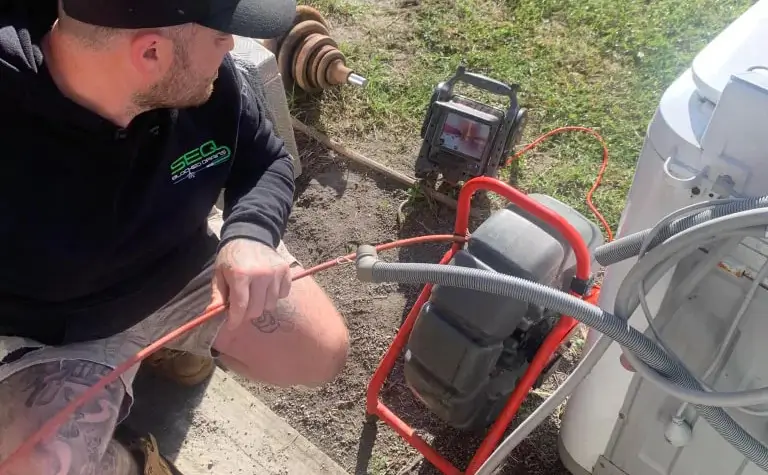
A drain snake reaches further into the pipe than plunging or p-trap cleaning, which makes it useful when those methods haven’t held. Available to hire from most plumbing and equipment suppliers across SEQ. Manual versions handle most domestic jobs; electric models generate more force and work better on compacted material, but they need careful handling in older lines.
In pre-1970s Brisbane homes, most sewer lines were laid in earthenware clay. That includes Queenslanders and post-war brick homes across suburbs like Paddington, Wilston, and much of the inner north, where pipe condition varies considerably depending on how much soil movement and root exposure has occurred over the decades. Clay becomes increasingly brittle as it ages, and a drain snake used with too much force can crack a pipe that was otherwise intact, adding a structural repair to what started as a routine clearance.
On newer PVC lines in Logan, Ipswich, and the outer Brisbane suburbs the risk is lower. But if the blockage returns within a few weeks of snaking, the underlying cause is still there. A snake clears the obstruction. It doesn’t tell you why the obstruction formed.
Can a wet/dry vacuum unblock a drain?
In specific situations, yes. A wet/dry vacuum set to liquid mode can generate enough suction to pull a solid obstruction out of a shower drain or basin trap where pushing it further down with a plunger would make things worse. Small toys, bottle caps, jewellery, hair clips that have dropped into a shower drain, those are the scenarios where this approach makes sense.
Create a tight seal over the drain with a wet cloth, set the vacuum to high suction, and run it in short bursts of 60 to 90 seconds. Check between bursts rather than running it continuously.
This isn’t a method for grease blockages or anything sitting deeper in the line. It’s most useful when you have a reasonable suspicion a solid object is sitting just below the drain cover. If a few attempts don’t shift it, pulling the p-trap is the better next move.
What’s the difference between DIY pressure flushing and professional drain jetting?
DIY high-pressure drain attachments, the type that connect to a standard garden hose, operate at a fraction of what a professional hydro-jetter delivers. That gap matters more than people expect.
Professional water jetting operates at 4000 PSI at 72 litres per minute. That’s enough to cut through compacted root mass, scour built-up grease from pipe walls, and clear debris that’s consolidated over years of accumulation. A garden hose attachment shifts loose surface material. It won’t touch a root intrusion or a grease plug that’s hardened inside the line.
Under the Queensland Plumbing and Drainage Act 2018, work on sewer lines requires a licensed contractor. QBCC licensing requirements apply to any drainage work beyond basic trap maintenance, and not just for bureaucratic reasons. High-pressure equipment used incorrectly on compromised pipe causes failures that are considerably more expensive than the original blockage. A cracked clay line under a driveway, a dislodged joint under a concrete slab, these aren’t rare outcomes when the wrong equipment meets old pipe.
If the blockage is in the main sewer line, or DIY methods haven’t held after a genuine attempt, a drainage specialist with a 4000 PSI jetter and a CCTV camera is the right call.
When does a blocked drain need a licensed drainage specialist instead of a DIY fix?
The clearest indicator that DIY has reached its limit is recurring blockage. A drain that blocks twice within six weeks has a cause that clearing hasn’t addressed. Root intrusion at a clay pipe junction or a displaced joint sitting under an established yard won’t resolve with another bi-carb application or a plunging session. These are structural issues that need a camera and a relining assessment.
A slow shower drain and a gurgling toilet both struggling on the same day points to the main sewer line rather than individual waste pipes. That requires a QBCC-licensed contractor equipped with a high-pressure jetter and CCTV. DIY equipment doesn’t reach that far into the system, and attempting to force a blockage on the main line without confirming what’s there can cause more damage than the blockage itself.
Sewage smell after rain is worth responding to promptly. It typically indicates a break or compromised seal somewhere in the sewer line, and under the Queensland Plumbing and Drainage Act 2018, defects that risk public health contamination require licensed remediation. Brisbane homeowners sometimes try to manage the smell with surface treatments, but the smell won’t resolve until the structural cause is addressed.
Ground-level overflow at a gully trap is the most urgent signal of the four. Wastewater surfacing outside the property means the blockage is deep in the system. Brisbane City Council, Logan City Council, and Gold Coast City Council each carry stormwater compliance obligations that come into play when overflow reaches a neighbouring property or a council easement, at that stage, emergency drainage attendance is appropriate.
How do blocked drains in Brisbane and SEQ homes differ from the rest of Australia?
South East Queensland’s drainage problems have a specific character shaped largely by the age of its housing stock. Inner Brisbane suburbs built before 1985 are still running on earthenware clay sewer lines that were never designed for modern household water volumes, and they’ve been under pressure from soil movement and root systems for decades. Subtropical storm seasons regularly push residential stormwater systems past their original design capacity too, which is a separate issue that can look identical to a sewer blockage until a camera confirms the difference.
Older inner Brisbane suburbs including Paddington, Ashgrove, Annerley, Morningside, and Camp Hill carry a high proportion of pre-1970s clay sewer lines. That pipe becomes porous as it ages. Root entry at pipe joints is common, cracking under reactive soil movement is common, and sections can collapse under driveways where ground load has shifted over decades. All of it shows up regularly on CCTV inspections of SEQ properties with recurring blocked drains.
Reactive soils in Logan and Ipswich put lateral stress on those pipes over decades. Mature trees, jacarandas, figs, camphor laurels lining older Brisbane streets, send roots toward water sources, and a hairline crack at a clay pipe junction is all the entry point they need. A sewer line that’s been cleared five times in two years isn’t a maintenance problem. It’s a structural one, and pipe relining is usually the answer, not repeated jetting.
Brisbane City Council, Logan City Council, and Gold Coast City Council each set specific obligations for property owners around stormwater discharge and connection point maintenance. Where a stormwater system overflows onto a neighbouring property or across a council easement, that moves into compliance territory. The requirements differ between councils, so checking the relevant local stormwater code before drainage work affecting shared boundaries is worth doing before any work starts.
If the drain keeps coming back, it’s worth finding out why
Most blocked drains across Brisbane, Logan, Ipswich, and the Gold Coast respond to the methods in this guide. When they don’t, the cause is usually something a camera needs to confirm before the next clear makes sense, otherwise you’re clearing the same problem on a shorter and shorter cycle.
SEQ Blocked Drains has been working on residential and commercial drainage across South East Queensland for over 25 years. QBCC licence 15406825. Same-day call-outs available across the region.
FAQS
Depends on the pipe material and what's causing the blockage. On a metal waste pipe with light grease buildup near the drain opening, boiling water can shift the problem. PVC is a different situation, the heat softens the material and puts stress on the seals around the trap. For plastic waste pipes, water straight from a hot tap works just as well on grease without that risk. Neither version does much on anything sitting further down the line or on a root mass.
If it keeps coming back, that's the answer. A drain that blocks, gets cleared, and then blocks again within a few weeks hasn't had its actual cause addressed. The other clear indicator is when more than one fixture is affected at the same time, a slow shower and a gurgling toilet on the same day typically means the main sewer line, not an isolated waste pipe issue. Ground-level overflow or sewage smell after rain are more urgent than either. Both point to a break or compromised seal somewhere in the drainage system, and that's work for a licensed contractor with a camera.
On plastic, copper, and clay earthenware, it won't cause damage. The limitation is what the method can actually do, not what it might harm. Bi-carb soda and vinegar agitate light surface buildup near the drain opening. For anything sitting further into the line, root intrusion, a displaced joint, accumulated scale on older earthenware, it makes no practical difference to the blockage.
Same tool, different names. Depending on the supplier or hire outlet, it gets called a drain snake, plumber's snake, or drain auger. All three refer to the coiled metal cable that extends into the pipe to break up or retrieve a blockage. Manual versions from most hardware and plumbing hire suppliers across SEQ cover most domestic jobs. Electric models are more powerful and better on compacted material, though they need careful handling in older clay lines where the pipe has become brittle.
A cup plunger works on a shower drain if you can get a reasonable seal over the opening. Remove the drain cover first if it lifts out easily. Press the plunger face flat against the surface, then use firm steady strokes, sudden force tends to break the seal rather than build pressure. A few attempts without improvement usually means the blockage is sitting past where plunging can reach. At that point a drain snake is the more useful tool before calling a drainage specialist.
On a drain that keeps blocking, a CCTV inspection is what tells you whether the problem is debris accumulation or something structural. That difference matters because the repair is completely different. Repeated jetting clears a grease buildup. It doesn't fix a fractured clay section or a root system that's entering through a pipe junction. Running a pan-and-tilt camera down the line confirms which one you're dealing with. For SEQ properties with pre-1980s clay sewer lines, getting that answer before the next clear typically costs less over two years than jetting a line that needs relining.
Basic trap maintenance and plunging sit outside the licensing requirement, that work is fine to do yourself. Anything involving the sewer line is a different matter. Opening inspection shafts, modifying connection points, and structural drainage repairs all require a QBCC-licensed contractor under the Queensland Plumbing and Drainage Act 2018. For properties going through a sale, this is worth knowing before any work starts. Unlicensed sewer work that surfaces during a building inspection can create complications around settlement timing and may affect certain home insurance provisions.